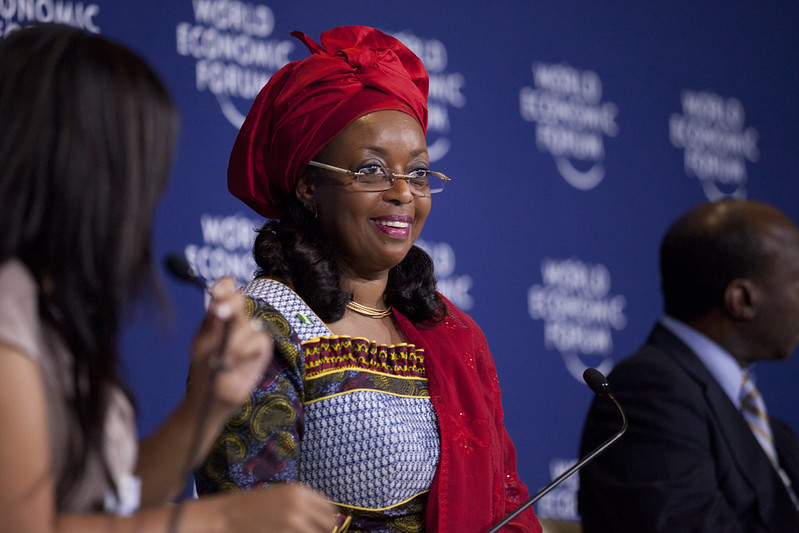
The trial of Diezani Alison-Madueke, former Nigerian minister for petroleum resources, kicked off in London today. She stands accused of awarding government contracts worth millions to high-profile businessmen in return for bribes whilst she sat at the helm of Nigeria’s booming oil industry.
The former first female president of OPEC is alleged to have accepted bribes of £100,000 in cash, designer goods from Harrods, the use and refurbishment of UK properties, chauffeur driven cars, flights on private jets, and private school fees. The UK was the site of much of this activity.
This is alleged to have happened between 2011 and 2015 when oil prices in Nigeria were booming. It was a time in Nigeria many have characterised as a state of policy capture, where business interests and political decision-making were dangerously close.
The trial is the culmination of a long-running, complex investigation involving cooperation between the National Crime Agency’s International Corruption Unit (ICU) and Nigerian authorities. Alison-Madueke’s brother Doye Agama, and businesswoman Olatimbo Ayinde are also charged with bribery offences.
This big case shows how the ICU – which operates on a shoestring budget – really punches above its weight in the global fight against corruption.
But it comes as the UK government has proposed major police reform which raise questions about the future of the ICU, the expert unit which investigated Alison-Madueke. The government’s plan to go from ‘local to national’ would subsume the NCA, the home of the ICU, within a new national policing service.
Zainab Saleem, Legal Fellow at Spotlight on Corruption, said:
“Coming at a time when anti-corruption norms are under threat around the world, this high-profile bribery trial against a former Nigerian cabinet minister is a vital sign of the UK’s continuing role in the global fight against corruption. It is also a timely reminder – as the government proposes a major overhaul of policing – of how a small team of specialist investigators in the NCA is punching above its weight, pursuing a multi-million pound bribery case on a shoestring budget.
With bribery allegations that turn on designer goods from Harrods and the use of luxury London properties, the case raises questions that hit close to home about the UK’s role as a safe haven for dirty money and the UK professionals who enable this. The domestic relevance of this case also lies in the scrutiny it invites about the adequacy of current safeguards to protect UK politicians from corruption.”
As part of Spotlight’s unique court monitoring programme, we track major court cases in the UK relating to corruption, foreign bribery, money laundering and asset recovery. By regularly attending court hearings, applying for court documents, and undertaking detailed analysis of these cases, we are well-positioned to provide expert commentary on the latest developments and develop a strong evidence base to inform our broader policy and advocacy work.
- The trial in R v Diezani Alison-Madueke, Doye Agame, Olatimbo Ayinde (Case numbers: U20231338, T20237167, T20237170) is scheduled to start on 27 January 2026 and finish by 24 April 2026.
- It follows a decade-long investigation by the National Crime Agency’s International Corruption Unit, working closely with Nigeria’s anti-corruption agency, the Economic and Financial Crimes Commission (EFCC).
- The NCA assesses it is a realistic possibility that over £100 billion is laundered every year through the UK or through UK corporate structures using high-end money laundering methods.
- The results of a government survey published in December 2025 revealed that 59% of UK adults are concerned about the impact of corrupt actors on the housing market.