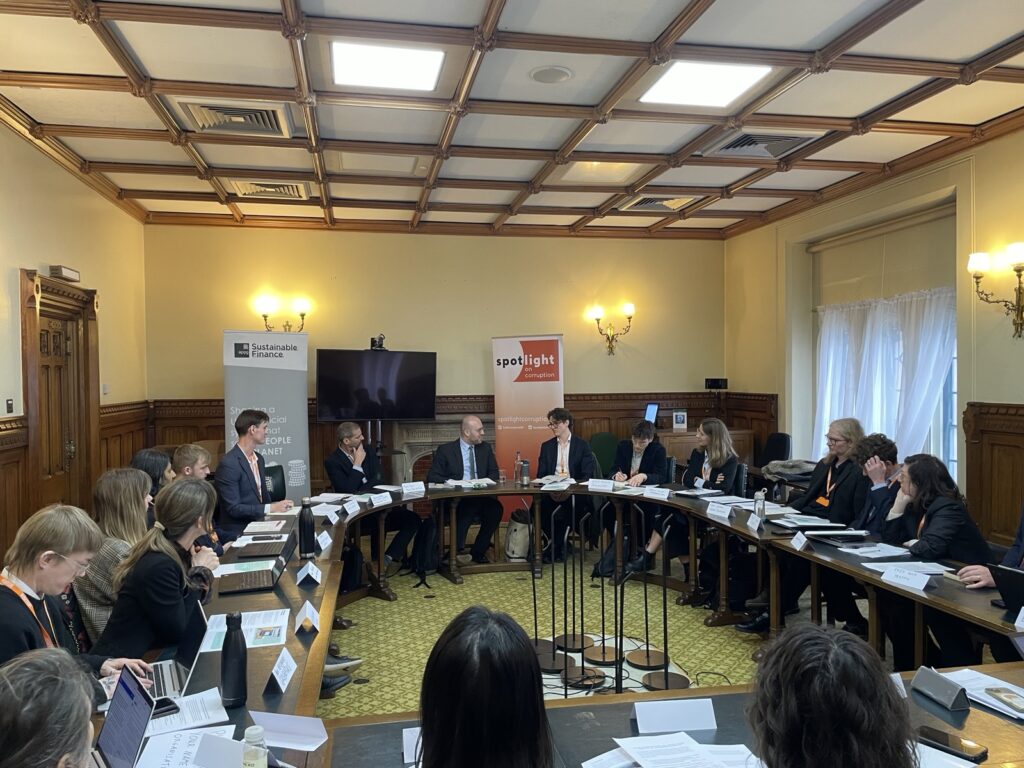
How can anti-corruption efforts help accelerate the transition to net zero and tackle environmental harm? And what opportunities exist to foster greater cross-sector collaboration on these issues?
These were the key questions discussed at a roundtable in Parliament launching the ‘Clean and Green’ manifesto in March 2026. Endorsed by 30 civil society organisations, the manifesto identifies areas of consensus where anti-corruption efforts in the UK can help tackle environmental harm.
Co-organised by Spotlight on Corruption and two All Party Parliamentary Groups focused on anti-corruption and sustainable finance, the roundtable brought together leading civil society organisations working to counter corruption and environmental harms while promoting social justice.
A rich discussion chaired by Lloyd Hatton MP highlighted several opportunities for further cross-sectoral collaboration to tackle corruption and environmental harm. These included:
- Leveraging opportunities at the UK hosted international summit on illicit finance to highlight the ways in which corruption enables environmental harm and exacerbates climate change. Coinciding with London Climate Action week in June 2026, the summit will spotlight how illicit gold is linked to some of the most serious environmental harms, including the pollution of rivers and destruction of forests.
Civil society could encourage the UK government to focus on tackling corruption and illicit finance that enables environmental harm through its upcoming Presidency of the G20 and the Financial Action Task Force, and through fora such as the UN Conventions Against Corruption and Transnational Organised Crime. - Pushing the UK to use its influence at the next UN Climate Change Conference (COP) to introduce stronger oversight of business participation to curb the influence of fossil fuel interests that risks undermining progress on tackling climate change.
- Sending evidence to the Ethics and Integrity Commission as part of its review into Lobbying, Disclosure, and Access to Government to urge much greater lobbying transparency to mitigate the risk that public policy is captured by vested interests, including lobby groups seeking to undermine action against environmental harm.
- Exploring opportunities to deploy strategic litigation to make the most of the UK’s powerful laws for tackling corruption and illicit finance where such criminality and environmental harm intersect. NGOs could apply for legal support through the London School of Economics’ new Sustainability Law and Policy Clinic or pro bono legal expertise through the International Lawyers Project. Organisations could also collaborate on efforts to expose and hold accountable the professionals who enable corruption that fuels environmental harm.
- Supporting joint advocacy on ongoing efforts to secure major reforms such as:
- a new legal requirement for companies in the UK to conduct due diligence on a comprehensive range of environmental harms in their supply chains;
- ‘polluter pays’ taxes;
- strengthening protections for whistleblowers and tackling abuse lawsuits known as SLAPPs;
- securing corporate transparency reforms in the UK’s Overseas Territories and Crown Dependencies; and
- radically improving climate finance transparency.
Next steps
The Clean and Green Manifesto is an innovative and novel initiative that we hope is just the beginning of more regular cross-sectoral collaboration in the areas highlighted in the manifesto, and beyond.
For its part, Spotlight on Corruption will continue collaborating with other anti-corruption campaigners and those working to protect the environment and promote social justice.
In particular, we will push for:
- Greater scrutiny and accountability of professionals such as lawyers, accountants and financiers in the UK who enable corruption that is linked to environmental harm.
- Major lobbying reforms to ensure access to decision-makers is more transparent and fair as well as wider reforms to protect and incentivise whistleblowing and stop SLAPPs.
- Greater recognition by UK law enforcement agencies of the frequent connections between corruption and environmental harm, building up the evidence base for action through our unique court monitoring programme.