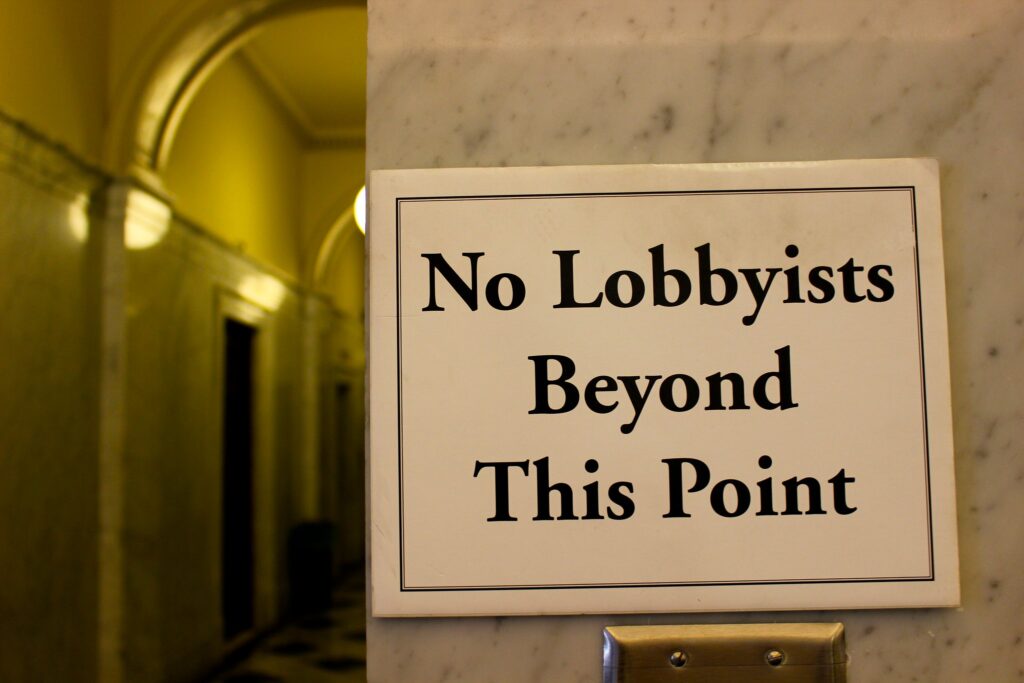
The Ethics and Integrity Commission’s sweeping review of lobbying transparency is a once-in-a-Parliament opportunity for ambitious reform.
Commissioned by the Prime Minister in the wake of the revelations about Peter Mandelson’s relationship with Jeffrey Epstein, it is looking at lobbying, the business appointment rules, and financial disclosures.
For too long, the UK’s lobbying transparency has been opaque and criticised by experts and industry groups alike. The UK is falling behind comparable jurisdictions, most notably the EU and other OECD countries, when it should be at the forefront of efforts to create open and transparent government.
That is why in our submission to the lobbying review, we are calling for the UK to adopt an EU-style comprehensive transparency register. This would bring together a much wider range of information on all those who lobby decision-makers alongside government transparency data.
This needs to be accompanied by tougher sanctions for non-compliance, more naming and shaming of government departments who fail to provide timely data on who ministers and senior civil servants are meeting with, and a statutory code of conduct for lobbying.
Why it matters
Transparency is a vital prerequisite to a modern democracy. It is only with transparency that the public can track who the government is meeting, in whose interests policy is being made, and whether there is fair and equitable access to policy-makers for a wider range of stakeholders.
The OECD’s recommendations on lobbying transparency – updated two years ago – start with the recognition that good government decision-making requires ‘a wide range of stakeholders’ to have ‘a fair and equitable opportunity to contribute to public decision-making’ in order to safeguard the public interest.
Transparency is also critical for building public trust, particularly, when trust is low to start with. The OECD found that 51% of citizens who find information about administrative processes easily available trust their government, whereas among citizens who don’t trust in government is at 22%. In the UK, trust in government is at just 27% – compared with 49% in Canada and 62% in Switzerland. Increased transparency, if done right, could significantly help build trust and ensure better decision-making in government..
The UK now lags seven other OECD countries on lobbying transparency – Canada, France, Ireland, Finland, Ukraine, Chile and Germany – who all have comprehensive lobbying registers and codes of conduct for lobbying. And it lags behind both the EU and Scotland, where the public have far greater insight into how policy is being made.
Our submission makes the case for the government to show it is serious about restoring public trust, ensuring better and fairer public decision-making, and ensuring a wide range of stakeholders get a say in key decisions by taking the following steps.
- Introduce a transparency register
The most impactful reform the government should make is the introduction of a statutory, comprehensive and combined transparency register, modelled on the EU’s system. This would bring together government transparency releases and the lobbying register into a single, accessible website.
Under this system, all lobbyists would be required to register on the website whenever they lobby ministers, special advisers, senior civil servants, and parliamentarians. They would disclose who they’re representing, their goals, and the legislative and policy proposals targeted.
In turn, the government should publish meaningful explanations of its meetings with lobbyists and party donors – not vague one-line descriptions as is currently the case.
Crucially, transparency rules should not stop at formal diarised meetings. Chance meetings at party conferences or conversations over WhatsApp can shape public policy just as much, and they should be recorded on the website accordingly.
The case for such a system is clear. Whereas at the moment, the public has to piece together the lobbying picture from two often irreconcilable and incomplete databases, a comprehensive transparency register would enable the public to find out who the government is meeting, and ensure the government itself, as well as those who lobby government, have a better picture of who is lobbying government and what they are saying behind closed doors.
The EU’s transparency register is not perfect and the UK has the opportunity to learn from its weaknesses. These include – as the European Court of Auditors found – weak enforcement, missing crucial data, and differing definitions of ‘meeting’ across the institutions. But despite its shortcomings, it still provides a useful model for how Britain could replace its patchwork system with a more comprehensive foundation.
- Remove exemptions to transparency
Having a comprehensive lobbying register would require the removal of three exemptions that have undermined lobbying transparency since the Lobbying Act was passed twelve years ago:
- The rule exempting in-house lobbyists from having to register, which means that only around 4% of lobbyists are currently captured.
- The rule exempting non-VAT-registered companies from having to register. This enables foreign-owned businesses to influence our politicians without transparency.
- The rule exempting organisations from having to register if they lobby only ‘incidentally’, enabling multiple influential lobbyists to avoid having to register.
Amongst the OECD countries doing better than the UK in the implementation of their lobbying regime, none has these exemptions to their lobbying register.
This will require small businesses, think tanks, and NGOs to register, as they do in Scotland and the EU. This is vital for ensuring complete transparency and for the public, government and the sector to understand who is in the room when policy is being developed and which stakeholders are being left out. With the right technology, a proportionate system can be designed which does not impose a significant burden.
- Bolster enforcement of lobbying rules
The fact that the highest fine the Office of the Registrar of Consultant Lobbyists can issue is £7,500 is laughable in the context of lobbying companies’ vast profits.
The UK should look instead to Canada, where the maximum fine is C$200,000 or the US where the maximum fine is $200,000 – fines which would act as a significant deterrent for those who invest large sums in lobbying activity and egregiously break the rules, but which could be tapered down depending on the size of the organisation.
Like Scotland, Canada, France, Ireland, Germany, and the EU, the UK should also adopt a statutory code of conduct for lobbyists. As an interim measure, it should ensure that those who lobby the government are signed up to the Public Relations and Communications Association’s or Chartered Institute of Public Relations’s (CIPR) codes of conduct. CIPR polling of lobbyists found that 83% are in favour of the UK having such a code.
- Improve transparency releases
As part of establishing a transparency register, the government must also take the opportunity to improve its transparency releases of ministerial, special adviser, and senior official meetings, gifts, and hospitality.
At the moment, the releases are infrequent, sometimes missing key data, and lack clear descriptions of meetings.
To create genuine transparency, the government should:
- Ensure data is released at least monthly, rather than quarterly, so the public knows who the government is meeting during, rather than after, decision-making processes. This would still be far behind other countries, such as Norway, which publishes its ministers’ agendas daily.
- Include special advisers’ meetings with lobbyists, rather than just media proprietors as is currently the case. Spads are key players in the development of policy in government and review after review has highlighted that their omission from transparency data is a serious gap.
- Include meetings with party donors, so the public has a better understanding of the influence they hold.
Without these changes, the UK cannot convincingly claim to have open and transparent government.
- Beef up the business appointment rules
The business appointment rules, whose weaknesses have been highlighted by the Committee on Standards in Public Life and the Public Administration and Constitutional Affairs Committee, are in need of serious overhaul.
This is despite the modest improvements the government put in place in July 2025, when it announced that ministers would be expected to forgo their severance pay if they broke the rules.
Specifically, the government should:
- Make the rules legally enforceable rather than rely entirely on those breaching the rules to voluntarily comply.
- Beef up the sanctions for breaching the rules. Having to forgo a ministerial severance payment of between £5,594 to £18,860 is nothing compared to the six- or seven-figure sums a minister can make on leaving office.
Other countries recognise this, with France, Austria, and the US all able to impose legally enforceable fines.
Without meaningful enforcement and credible penalties, the UK’s business appointment rules risk remaining what critics have long argued they are: guidance that can be ignored when the rewards are high enough.
- Lower the threshold for financial disclosure
Another reform the government should make is to the threshold for financial disclosures for ministers.
The system in the UK government is inconsistent and complex: whereas peers have to declare shareholdings above £100,000 or those that amount to a controlling interest, for MPs the declaration threshold is shareholdings worth over £70,000, where they exceed 15% of a company’s share capital, or where the interests might reasonably be thought to influence them. Ministers’ shareholdings below the threshold set by their Parliamentary status are only declared if they are relevant to their portfolio.
By comparison, members of the devolved assemblies in Scotland, Wales and Northern Ireland must declare shareholdings if they exceed 50% of their salary, set at £38,855 in Scotland, £39,908 in Wales and £33,600 in Northern Ireland.
Bringing UK politicians’ financial disclosure threshold into line with the devolved assemblies would shine greater light on their financial interests and create consistency and clarity across the UK.
Time to protect our system
Both the previous and current governments have ignored recommendations made by the Ethics and Integrity Commission’s predecessor, the Committee on Standards in Public Life, which found in 2021 that the UK’s lobbying transparency regime was not fit for purpose.
The Public Administration and Constitutional Affairs’ Committee post-legislative scrutiny of the 2014 Lobbying Act concluded in 2024 that should concerns about the poor state of government transparency releases “go unaddressed, the case for a register of all lobbying activity should be revisited.” That moment has now arrived.That is why we are calling for fundamental and ambitious reforms to the UK’s lobbying transparency regime – reforms that would build public trust and ensure the regime is worthy of a modern democracy.