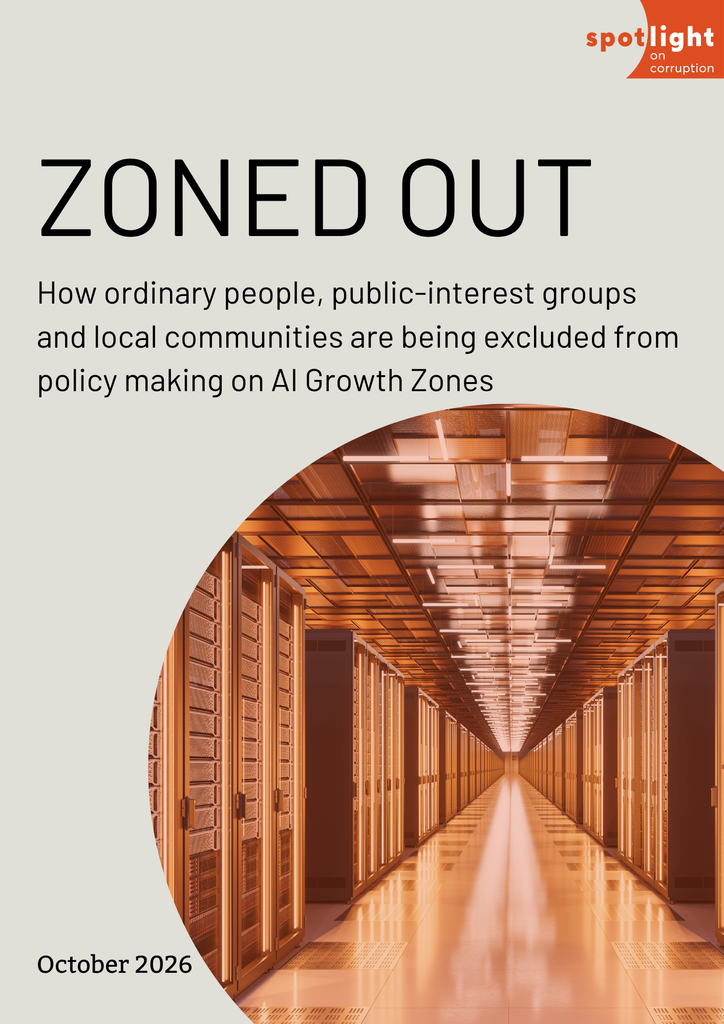
New Spotlight on Corruption report ‘Zoned Out: how ordinary people, public-interest groups, and local communities are being excluded from policy making on AI Growth Zones’ finds businesses dominate access to ministers and senior officials as the government pushes ahead with AI Growth Zones without national-level public consultation.
Zoned Out finds that between July 2024 and June 2026:
- 84% of ministerial stakeholder meetings on data centres were with businesses or private-sector trade associations.
- Ministers met just two community groups – and both after the government had already decided to designate their areas as AI Growth Zones.
- Ministers, permanent secretaries, and directors general met no environmental NGOs.
- Permanent secretaries and directors general held no meetings with community groups.
- AI companies hired 38 ministers and senior civil servants.
The government has undertaken no national-level public consultation on AI Growth Zones or AI data centres more broadly. And there were no independent consultations of local communities where AI Growth Zones were selected. Very surprisingly, local councils themselves appear to have little engagement, with ministers, permanent secretaries, and directors general having held just one meeting with local authorities before designating their areas as AI Growth Zones.
Given the significant concerns about the environmental impact of data centres, including risks they will consume large amounts of water and electricity, and lead to higher emissions, our report finds that the government does not appear to be taking these risks as seriously as they should. There are no environmental groups on the government’s Sustainability Working Group which met only once in the 17 months from when it was established in January 2025 up to July 2026. And almost two years after announcing its AI Growth Zone policy, the government has yet to release national-level environmental and social impact assessments.
Germany, Canada and Ireland have all conducted significant public consultations on their national data centre strategies, leading to more robust environmental requirements.
Spotlight on Corruption is calling for a pause on new AI Growth Zones and AI data centres until the government establishes strict criteria for their development.
The report recommends that the government:
- Commits to equitable access to decision-makers on AI policy. This should include publishing stakeholder engagement plans and meeting public-interest groups such as community and environmental groups alongside industry representatives, and adopting innovative participation mechanisms to inform AI policy and data centre strategy.
- Is far more transparent about the development of AI policy. This should include immediately publishing environmental and social impact assessments for the AI Growth Zone strategy and each AI Growth Zone, publishing detailed monthly data on meetings with AI companies, especially those with special advisers.
- Ensures far greater accountability for AI policy. This should include placing a moratorium on new data centres until stringent regulations are in place, requiring data centres to meet high environmental standards and report on emissions, electricity, and water use, and requiring the financial sector to report annually on the impact of their AI adoption.
Kamila Kingstone, Senior Policy and Campaign Lead, Defending Democracy Programme at Spotlight on Corruption, said:
“Given that the environmental harm caused by data centres is well known, it is extraordinary that the Department for Science, Innovation, and Technology failed at the most senior level to speak to environmental NGOs or community groups when developing its AI Growth Zone policy.
It suggests a solid in-built bias towards the interests of corporations and away from those who will be most impacted by the policy and who might say things it doesn’t want to hear.
Until the government has put in place stringent environmental protections and reporting processes, along with extensive engagement, there needs to be a moratorium on the building of new data centres.”
Diane Davidson, Secretary of Woodhall, Faskine and Palacecraig Conservation Group, a community group based close to the North Lanarkshire AI growth zone, said:
“It is not a surprise that big tech has the ear of Ministers even as we are left out in the cold, facing projects which will have horrendous impacts locally as well as making it impossible to meet our climate commitments.
Woodhall, Faskine and Palacraig conservation group wrote to the UK Government, and to North Lanarkshire Council asking for transparency on the AI growth zone, and for meetings, and didn’t even get responses.
This makes it even more of a David and Goliath fight as, not only do we have all the power of big tech against us, but we can’t even get the council, and the government to listen to us.”
ENDS
Notes to Editors
- Download the Zoned Out report at: https://www.spotlightcorruption.org/report/zoned-out-how-ordinary-people-public-interest-groups-and-local-communities-are-being-excluded-from-policy-making-on-ai-growth-zones
- There have been other reports on the number of hires made by AI and tech companies of politicians and civil servants that have highlighted different figures. This disparity is because we have focused on ministers and civil servants (not party officials), looked at the period July 2024-September 2026, and focused on senior civil servants, not delegated (junior) grades.