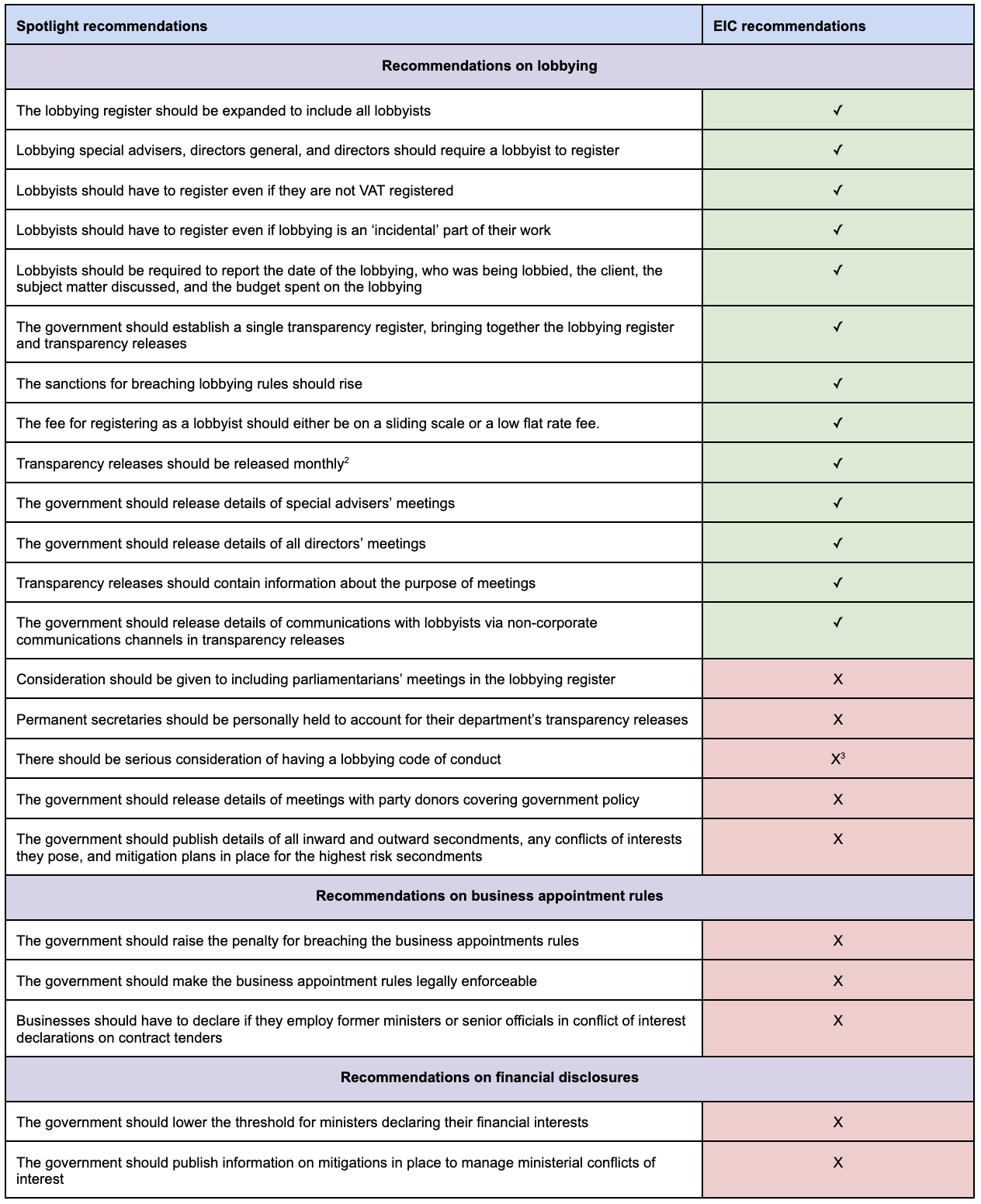
The new Ethics and Integrity Commission (EIC) has published a landmark review, calling for sweeping reforms to lobbying and transparency rules that would shine a light on the shady lobbying that goes on behind closed doors in the UK.
Commissioned by the Prime Minister in response to the allegations about Peter Mandelson’s relationship with Jeffrey Epstein, the EIC have clearly listened to the public’s outrage and made ambitious recommendations, some of which have never been on the table before.
With trust in politicians at record lows, the government should crack on with implementing these recommendations as quickly as possible, demonstrating its commitment to tackling undue influence and unfair access.
It should also go further, however, and implement more ambitious reforms that would make the lobbying rules more comprehensive and make the UK a leading light in transparency around the world.
Single transparency register
A major EIC recommendation, which we strongly support, is for the creation of a digital platform: a one-stop shop for anyone wanting to find out who is lobbying the government – how, when, and for what purpose.
Lobbyists would have to input information about their clients, their meetings and communications with government, what they are lobbying on, and how their organisation is funded.
On the other side, the government would input its transparency releases: the dates of meetings with lobbyists, the purpose of the meeting, and who attended.
This would end the current ridiculous situation, where anyone trying to find out who is lobbying the government has to trawl through dozens of websites and hundreds of spreadsheets, and try to match them up with an incomplete, and sometimes irreconcilable, lobbying register.
This is an overdue and much needed reform. It would mean that anyone could easily find out who has been influencing the government, marking a shift in the UK’s political culture away from backroom dealing and towards openness and transparency.
Comprehensive lobbying register
Another ambitious and much needed EIC recommendation is to make it mandatory for all lobbyists, including in-house lobbyists, to register.
This would be a serious improvement on the current lobbying register, which only covers consultant lobbyists, who make up – according to Transparency International UK – just 4% of all lobbyists.
The EIC’s recommendations would also close two gaping loopholes, requiring organisations not VAT-registered, and those for whom lobbying is only ‘incidental’ to their work, to join the lobbying register.
This would mean that small businesses and NGOs would have to register for the first time, which they already have to do in Scotland and the EU.
This is a vital step, holding all organisations to the same standards and giving the public full transparency over who is influencing our politicians, helping to reveal whether there is fair access to decision-makers. The financial impact of this on smaller organisations would be mitigated with a graduated fee structure.
In addition, the EIC recommends that those who lobby special advisers, directors general, and directors should have to register, rather than just those who lobby ministers – another crucial measure in ensuring that the register captures all influential lobbying happening across government.
Transparency releases
As our joint research with Transparency International and Unlock Democracy showed, government transparency releases suffer from being inaccessible, vague, and published long after the meetings took place.
The EIC’s recommended improvements to transparency releases include: that the government should publish them monthly on the digital platform – as monitored with a timeliness dashboard – should add more detail on the purpose of the meetings, and should include the details of all meetings held by special advisers, who currently only have to declare meetings with media executives.
Crucially, the EIC has also recommended that the releases include communications from lobbyists through non-corporate channels, such as WhatsApp, and informal meetings, such as at party conferences. This was a recommendation made by CSPL, and would involve capturing a type of highly influential lobbying that has otherwise been going undocumented.
Sanctions
The EIC also recommends that the government takes another vital step by increasing the sanctions available for the Lobbying Registrar to impose on lobbyists who breach the rules. Currently standing at just £7,500, this is a derisory deterrent to rule-breaking.
The EIC recommends that the government consults on what the sanction should be raised to, but suggests a figure of £75,000. This would bring the UK more in line with Canada (where the maximum fine is $200,000), the US ($200,000), Austria (€60,000) and Germany (€50,000), and would give the lobbying registrar the teeth it needs to enforce the rules.
Opportunities to go further on lobbying
There are a few areas where the government should go even further than the EIC has recommended, to make sure that the lobbying rules are comprehensive. In particular, the government should:
- Establish a statutory code of conduct, as exists in Scotland, Canada, France, Ireland, Germany, and the EU. While the Public Relations and Communications Association and the Chartered Institute for Public Relations have codes of conduct for their members, they are voluntary to sign up to. A mandatory code could boost public confidence and mean that lobbyists could be more easily held to account for poor conduct.
- This is also an opportunity for Parliament to look at how lobbying of parliamentarians by special and commercial interests can be captured, particularly where parliamentarians are designated frontbench spokespeople or are leaders of opposition parties who are in receipt of public funding.
- Make clear that meetings with party donors are covered when they touch on government policy – a vital measure so that the public can see in whose interests the government is making policy.
- Require permanent secretaries to take responsibility for transparency releases, potentially being denied annual performance-related bonuses if they are not up to high-enough standards.
- Publish details of inward and outward secondments, so the public can identify any particularly close relationships between the private sector and government.
Fair access
Transparency on its own, however, is not enough. If the government really wants to demonstrate its commitment to making policy in the public interest, it needs to ensure fair access for the public and civil society to the policy-making process.
Spotlight on Corruption’s Levelling the Playing Field report found that 92% of the Department for Business and Trade’s meetings under the previous government were with corporations and just 2% were with civil society – meaning that a plethora of public-interest voices were being crowded out.
To combat this, the government needs to combine greater lobbying transparency with broader measures, such as proactively reaching out to under-represented voices, using innovative participation mechanisms, such as citizens’ assemblies, and running more inclusive consultations.
Such measures would bring in a wider range of voices, diluting the influence of private interests, improving policy-making and rebuilding floundering trust in politics.
Business appointment rules
There are also opportunities for the government to go further on the business appointment rules, particularly in their enforcement.
The EIC has recommended that individuals who breach the rules should be named and shamed but this is unlikely to be enough to deter rule-breaking. In addition to this, the government should consider introducing legally enforceable and stronger sanctions.
The EIC has expressed concern that this could deter talented individuals from joining government, but the government arguably shouldn’t be employing people who are put off by fair and clear rules.
Financial disclosures
The government should also go further on improving ministerial financial disclosures. The EIC has recommended that the government improves its data collection, reduces duplication in the information it asks for, and improves declarations’ accessibility, but there are more substantial improvements the government can make.
Specifically, the government should lower the threshold for ministers to declare their financial interests (1), bringing it in line with the devolved administrations, where members of devolved parliaments have to declare interests valued over much lower thresholds (£38,855 for Scotland, £38,190 for Wales and £25,000 for Northern Ireland).
It should also publish senior civil servants’ conflicts of interest, and information about how all conflicts of interest are being mitigated.
With increasing attention on politicians’ sources of funds, these measures would give the public invaluable insight into how their business dealings interact with their policy-making, and boost public confidence that they are being effectively managed.
A line in the sand
The EIC’s recommendations, if fully implemented, would be transformative for British political culture, bringing the UK in line with its international counterparts.
It is vital that the government adopts these recommendations in full, including through legislation in the next King’s speech. In the meantime, the government should, as a priority, get on with implementing the measures that do not need legislation, including ensuring monthly transparency releases, as well as including meetings with special advisors and informal communications in these releases.
In many of its recommendations, the EIC’s report is the follow-up to the Committee for Standards in Public Life (CSPL) Standards Matter 2 report from 2021, whose most substantive recommendations previous governments largely ignored. The current government mustn’t let that happen again, but rather must seize this opportunity and embrace the changes our political system sorely needs.
(1) Peers only have to declare shareholdings above £100,000 or those that amount to a controlling interest. For MPs, the declaration threshold is shareholdings worth over £70,000, where they exceed 15% of a company’s share capital, or where the interests might reasonably be thought to influence them. Ministers shareholdings below the threshold set by their Parliamentary status are only declared if they are relevant to their portfolio.
(2) The EIC recommends that departments should have to submit their returns monthly, with the government publishing those returns no more than two months later.
(3) Although the EIC has not called for a code of conduct, they have said that they ‘may choose to review in future whether the new system has had the intended effect or whether there should be a full regulatory regime including a statutory code of conduct’. See page 22.