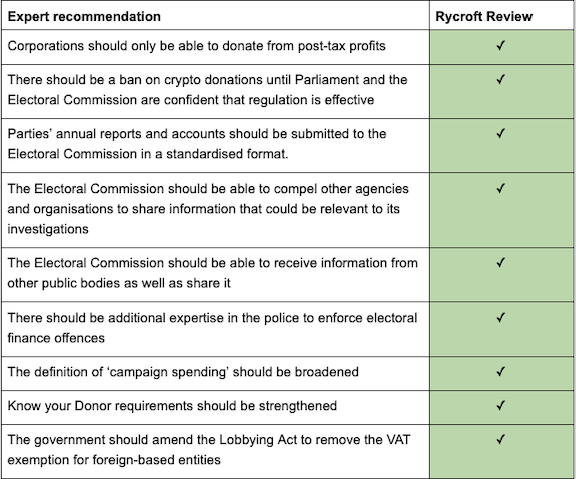
Yesterday the government announced that it would immediately implement two crucial recommendations from the independent Rycroft Review into foreign interference:
- A cap on overseas donations and
- A ban on cryptocurrency donations.
These are bold measures, and welcome. Rycroft rightly recognised that they are justified by the real and unique risks that both overseas donations and cryptocurrency pose in terms of foreign interference in UK politics.
His proposal for a cap on overseas donations is particularly ambitious, and his recommendation that a ban on all crypto donations should only be lifted once Parliament and the Electoral Commission are sure “relevant regulation is effective” is a solid one and fits with safeguards we have been calling for.
As the Representation of the People Bill continues through Parliament, the crucial question now is will the government implement the full slate of his bold recommendations – all 17 of them – and take up his call in some areas – such as campaign spending and donation caps – to go further?
Our analysis looks at the good bits in Rycroft and where he didn’t go far enough.
a. Political Finance
Rycroft’s really important and very welcome recommendations to tighten up political donations include:
- Profit test for corporate donations: Rycroft went particularly hard on the need for company donations to be limited to post-tax profits rather than revenue as the government is proposing. This is something the Electoral Commission has been asking for, and that the Committee on Standards in Public Life recommended.
- Transparency in campaign spending: Rycroft has called for a shift to a ‘year-round regime’ on transparency in how non-party campaigners and candidates report their campaign spending. This will be a major step forward. He also called for some crazy transparency loopholes to be closed, and for much more standardised reporting on updated campaign spending types. Again – these are all things that experts and campaigners have long called for.
- Strengthening the Know Your Donor checks: Rycroft has called for this to be made much tougher and closer to the anti-money laundering checks that businesses have to do. We couldn’t agree more – and have been making that case in briefings to Parliament.
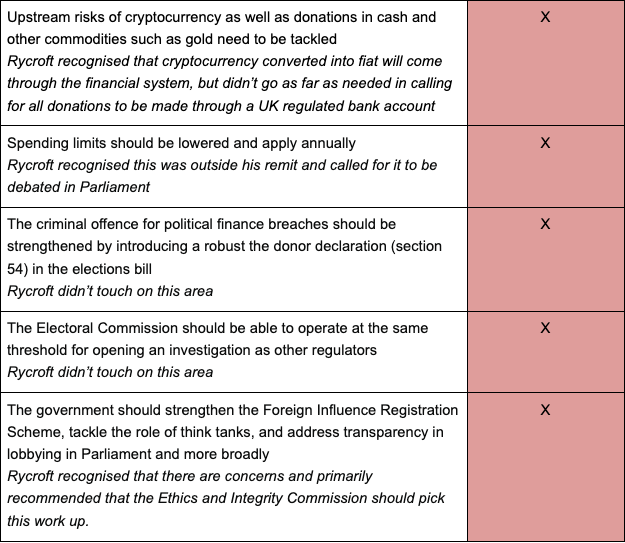
But Rycroft also stopped short in three key areas:
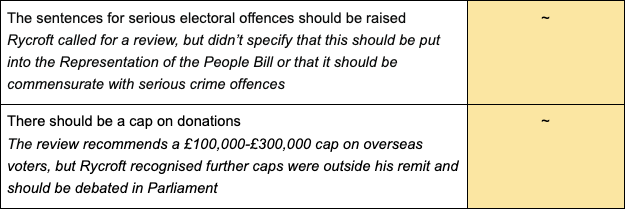
- Setting more reasonable spending limits and donations caps: Rycroft made a point of stating that these were outside of his remit. He did however make a plea that “the issue of spending limits and wider caps is one for the political class as a whole to consider if it wishes to restore confidence in the political process and to keep big money out of UK politics.” And he called for it to be debated during the passage of the government’s Elections Bill.
- Establishing annual spending limits: While transparency on campaign spending will be a ‘year-round regime’ under his proposals if they are implemented, limits on that campaign spending will not. We’ll continue to be calling for annual spending limits to make sure parties can’t gain an unfair advantage by ramping up expenditure ahead of the ‘regulated’ period.
- Tackling upstream crypto donations: One key area Rycroft stopped short on was tackling crypto donations that are converted into cash ahead of being donated. These risks also apply to cash donations and donations in other high-risk commodities such as gold and fine art. A critical way to address that would be to make sure all donations must be made via a UK regulated bank account.
b. Enforcement
Rycroft made some crucial recommendations about beefing up enforcement which are essential if any of the rules on political finance in the government’s elections bill are to bite:
- Improved Electoral Commission powers: Rycroft recommended ensuring that the Commission can require information from other agencies it shares information with, and can require information from any person or body who holds material it needs to carry out its functions. These are recommendations that experts and Parliamentarians have made and that we made in our report out this week. They would be a game changer for beefing up the Commission’s enforcement and must be implemented speedily.
- Measures to beef up national level criminal enforcement: Rycroft recommended the creation and resourcing of a centre of police excellence on complex criminal offences involving foreign interference. This is welcome, especially the recognition that there must be criminal enforcement and specialised police expertise to do this. Just last week, the Joint Committee on National Security Strategy backed our recommendation that a Political Finance Enforcement Unit be established and that enforcement bodies such as the National Crime Agency and Met Police should provide annual resourcing updates to that Committee. The government will need to consider these together as recommendations.
- Lowering the burden of proof and a review of sentences: Perhaps most radically, Rycroft recommended lowering the burden of proof for criminal offences – something law enforcement has called for. While his call for a review of sentences is welcome, it would be disappointing if the opportunity to amend sentences in the Representation of the People Bill was missed, and we have been calling for them to be raised to 10 years in line with other serious crime sentencing levels.
But Rycroft stopped short in recommending:
- A new criminal offence: Law enforcement bodies can only enforce good laws. The NCA and others have consistently highlighted huge gaps in the law, particularly in relation to donations made indirectly via legitimate donors. The JCNSS picked up our recommendation in its report last week that the Representation of the People Bill should include a new robust donor declaration which would form the basis for a much more robust criminal offence. This is critical if we are going to get better criminal enforcement.
- Lowering the Electoral Commission threshold for regulatory investigations: Under Rycroft’s proposals, law enforcement will operate at a lower burden of proof when bringing criminal cases. In effect, that means the Electoral Commission and law enforcement will then be operating on the same burden of proof, due to the Commission’s high threshold for opening investigations. If the Commission is to play a more proactive role in regulatory enforcement, its threshold for opening investigations needs to also be lowered below the standard for opening criminal case – which would bring it in line with other regulators.
c. Lobbying
Outside political finance, Rycroft also looked into the UK’s threadbare lobbying transparency regime. While he provides some wide-ranging and insightful analysis on the risks, he only made one concrete recommendation for reform which was that:
- The loophole for foreign lobbyists should be closed: The current VAT exemption that allows foreign-based entities to escape having to register as a lobbyist is a major loophole – as our complaint about Global Counsel’s lobbying following a Democracy for Sale investigation revealed.
- His other recommendation in this area was that the Ethics and Integrity Commission’s (EIC) new review of lobbying rules should be expanded to look at the “potential channels for foreign money to flow into the wider political eco-system.” It will be important for the EIC to pick up his points about think tank transparency, lobbying by peers in the House of Lords, and how enforcement of the Foreign Influence Registration Scheme could be beefed up.