The Electoral Commission gave timely evidence to a parliamentary inquiry this week on the government’s flagship Representation of the People Bill. Chief Executive of the Electoral Commission, Vijay Rangarajan, told the MHCLG Committee they welcomed the Bill as it will “close off very long held weaknesses”, but that in the “political finance space … several things should be strengthened”.
This comes as the government tabled another mammoth and highly technical tranche of 180 amendments to the Bill, and as peers gear up to scrutinise the Bill’s political finance provisions during committee stage in the House of Lords over the next few weeks.
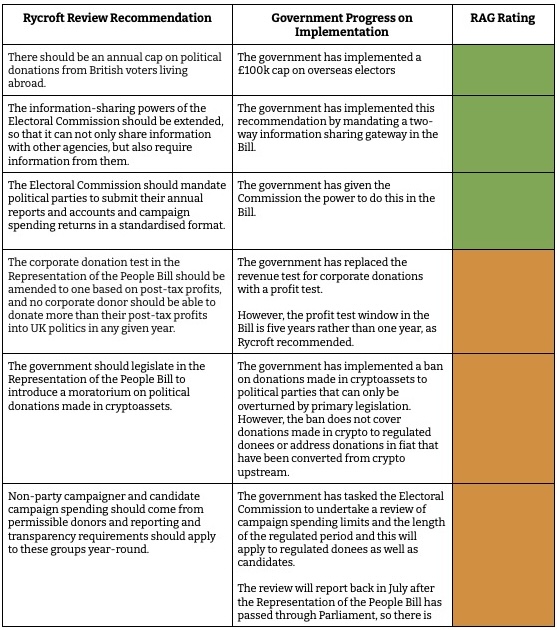
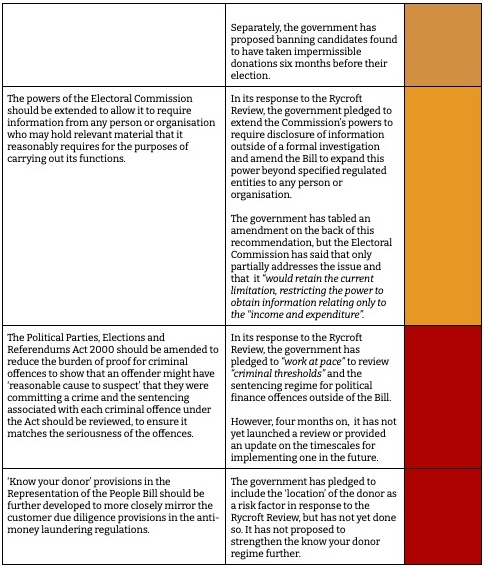
Here we lay out the issues the Electoral Commission raised, how Peers are addressing these gaps, and provide a scorecard on how well the government has implemented the recommendations of its independent Rycroft review on foreign interference in UK politics to date.
1. The complexity of the Bill
The government has so far tabled almost 300 amendments to the Representation of the People Bill in total during the passage of the bill through Parliament. Many of the amendments which cover the political finance regime are incredibly complex. For example, one government amendment tabled in the Lords that introduces donor declaration requirements for overseas electors runs to five pages.
This has sparked renewed calls from the Electoral Commission, politicians and campaigners for the consolidation of electoral law. Sam Hartley, director of policy at the Commission told the Committee that the regulated community needs some reassurance that electoral law will be consolidated in the future as the system is currently too complex. This is likely to add to the difficulties of implementing and enforcing new provisions.
Vijay Rangarajan told the inquiry that the Electoral Commission has been working on the implementation of the Bill for “over a year”, but voiced concerns over the “tight” timeframe they have to consult with and train political parties, candidates and their volunteers over how they should comply with the new and incoming rules around donation and expenditure.
Lord Pack has now tabled an amendment to the Bill that would require the government to report annually to parliament on its progress in consolidating electoral law and commencing other laws that have not currently been commenced. Lord Kinnoul has also put forward an amendment that would require the government to carry out a review into the effects of the Representation of the People Bill on the complexity of the statute book on electoral law and make recommendations on how to simplify it.
2. Donations caps and spending limits
The need for a donation cap is likely to be at the top of the agenda for upcoming debates in the Lords, with peers having tabled eight different amendments on how and where an upper donations limit should be set. These range from a proposed cap of £10,000 tabled by Baroness Bennett, a £50,000 cap from Lord Wills, a £500,000 cap from Lord Blunkett and a £5 million cap put forward by Lord Carlile.
While the Electoral Commission wasn’t asked about the cap, Sam Hartley – its director of policy – confirmed that the regulator has now done initial consultations with political parties on its campaign spending review, with no party having registered opposition. The Commission will report back on by July 2027 – after the Bill has passed.
There are a range of amendments to the Bill that would tighten up spending limits sooner rather than later. These include Lord Blunkett’s amendment to reduce spending limits by 15% and Lord Pack’s amendments to ensure spending limits apply all year round and include staff costs and membership communications. Lord Carter’s amendment would make sure spending limits can only be amended on a recommendation from the Electoral Commission, and Baroness Pinnock’s amendment would close the longstanding loophole around money spent in local elections promoting a national party without reference to the local candidate or local area.
3. The ‘know your donor’ regime
The new know your donor provisions in the Bill – requiring political parties to conduct a range of checks on larger donations – was welcomed by the Commission in their evidence as “a great step forward”.
However, Sam Hartley argued that the ‘location’ of a donor and any other factors that a reasonable party would consider relevant should be added to the list of checks. This reflects a recommendation made by the Rycroft Review, which states that the list “should be further developed to more closely mirror the customer due diligence provisions in the anti-money laundering regulations”. The government accepted this recommendation in responding to the review but is yet to table an amendment to this effect.
Lord Pack has an amendment to include location as a risk factor, and Baroness Hodge’s amendments would require source of funds checks by parties and checks on any other risk factors that a reasonable person considers to be relevant.
4. The Electoral Commission’s investigation powers
In response to the Rycroft recommendations, the government has given the Electoral Commission powers to share and request information from law enforcement agencies and other relevant public authorities, which has been welcomed by the Commission.
It also tabled an amendment to the Bill that partially implements another recommendation to give the Electoral Commission power to request information from a third party outside of a formal investigation.
However, the Electoral Commission has highlighted that the government’s amendment limits its power to obtain information “only to the “income and expenditure” of that third party.
Sam Hartley told the committee that access to a range of materials from actors beyond those it regulates is vital for the Electoral Commission. This might include social media platforms in order to verify a political party’s campaign spending or a crypto exchange in order to confirm the credentials of a wallet holder who may have converted crypto to fiat before donating to a political party.
Both Lord Pack and Baroness Hodge have tabled amendments to give the Electoral Commission powers to require information before launching a formal investigation and from any person or organisation who may hold relevant material, without limitations on what it can request.
5. The criminal enforcement gap
Vijay Rangarajan told the committee that he welcomed the Commission’s new powers to impose civil penalties for many offences that were previously subject only to criminal ones (meaning they were rarely enforced). He noted that criminal prosecutions are best left to law enforcement bodies with specialist expertise in financial crime.
However, he reminded the committee that “there has never been a prosecution under the Political Parties, Elections and Referendums Act”, despite the fact that the Commission has passed on many potentially serious cases to the police in recent years.
There is a well recognised criminal enforcement gap around political finance offences. In response to this the Rycroft Review recommended the creation and resourcing of a “centre of police excellence” for investigating political finance offences. The government only agreed with “the spirit” of the recommendation and claimed that existing structures form a centre of excellence, although it highlighted that upcoming police reforms provide an opportunity to address this.
Given police reform may take many years, Lord Pack has tabled an amendment to require the National Crime Agency to set up a specialised unit dedicated to investigating crimes related to the conduct and procedures of elections.
Rycroft further recommended that the government:
- reduce “the burden of proof for criminal offences to show that an offender might have ‘reasonable cause to suspect’ that they were committing a crime” and
- ensure “sentencing associated with each criminal offence under the Act should be reviewed, to ensure it matches the seriousness of the offences”.
The government stated that it would develop proposals for changing the sentencing regime and criminal thresholds outside of the Representation of the People Bill. Four months on, there has not been a substantive update from the government on how it intends to do this.
Currently the vast majority of political finance offences including new ones created by the Bill are subject to a one year sentence. As law enforcement has highlighted to parliament, this provides little incentive for law enforcement to investigate – given that a conviction is likely to lead to a suspended sentence – and is too low to enable them to use more serious investigative powers.
In its last tranche of amendments, the government has brought forward some amendments that make minor tweaks to the current sentencing for political finance offences, but have not done anything substantive to increase them. These include adding language around sentencing in devolved administrations and adding failure to make declarations by overseas electors and corporate entities a criminal offence under the National Security Act’s foreign interference regime incurring a four year sentence. This is likely to apply only in exceptional circumstances.
Baroness Hodge has tabled an amendment that would address the criminal enforcement gap by increasing the maximum sentence for the main political finance offence, section 61(1) from one to ten years. In addition, Lord Kinnoul has tabled an amendment that would lower the standard of proof for the main offences targeted at evading donation rules, by including ‘recklessly’ as well as ‘knowingly’ in the PPERA.
6. The ban on crypto donations
The government has placed a retrospective ban on crypto donations to political parties since March 2026, in response to recommendations from the Rycroft Review. This ban does not extend to regulated donees such as MPs and candidates or explicitly apply to donations that have been converted from cryptocurrency.
In response to an amendment tabled by Liam Byrne during the Commons stages of the Bill that intended to close down these loopholes, HCLG minister Florence Eshalomi said, “This is an area that the Government are definitely keen to continue to review, ensuring that we end any unintended loopholes that may still arise.” However, the government has yet to bring forward further amendments on this.
Vijay Rangarajan told the committee that the ban is “useful, implementable and clear”, but that the Electoral Commission favours a moratorium “that would then end when we and probably others as well such as financial regulators were content that there is a kind of crypto that gives electoral law what it needs”.
He said that it is difficult to extend the ban to donations converted from crypto into ‘fiat’ largely due to the fact that while the Electoral Commission can trace crypto transactions through the blockchain, it is challenging to pin a real world identity onto who controls the wallets making these transactions.
Without further amendments to tackle the loopholes this creates, as we and RUSI have highlighted there will remain a backdoor for foreign interference risks and illicit money entering our political system.
To address this in a proportionate and targeted way, the government needs to come forward in the final stages of the Bill with concrete proposals about how it will use the know your donor and donor declaration regimes to cover these ‘upstream’ crypto donations.
7. Pre-candidacy donations transparency
The committee heard the Electoral Commission’s concerns about a proposal the government has been discussing for the Bill covering candidates who have taken impermissible donations six months before their election. Under these plans, candidates would be banned for standing for office if they are found to have taken illegal donations.
The government has not yet brought forward amendments to this effect. But this would be part of the government’s response to the Rycroft Review which has recommended that “non-party campaigner and candidate campaign spending should come from permissible donors.”
However, Vijay Rangarajan said the proposed punishment was “hard and high” and they want “to work with the government to find a more proportionate solution”. He suggested that candidates should be made to return the donations within 30 days in line with the rules that political parties and regulated donees are subject to.
State of play on implementation of the Rycroft Review:
In July 2026, the government committed to “accepting all the recommendations made by Mr Rycroft and moving forward with a wide-ranging programme of reform”.
Four months on from its response, we have tracked implementation to date on 9 of the 17 recommendations which could have been acted on directly in this Bill.
Click here to open a pdf of the table